
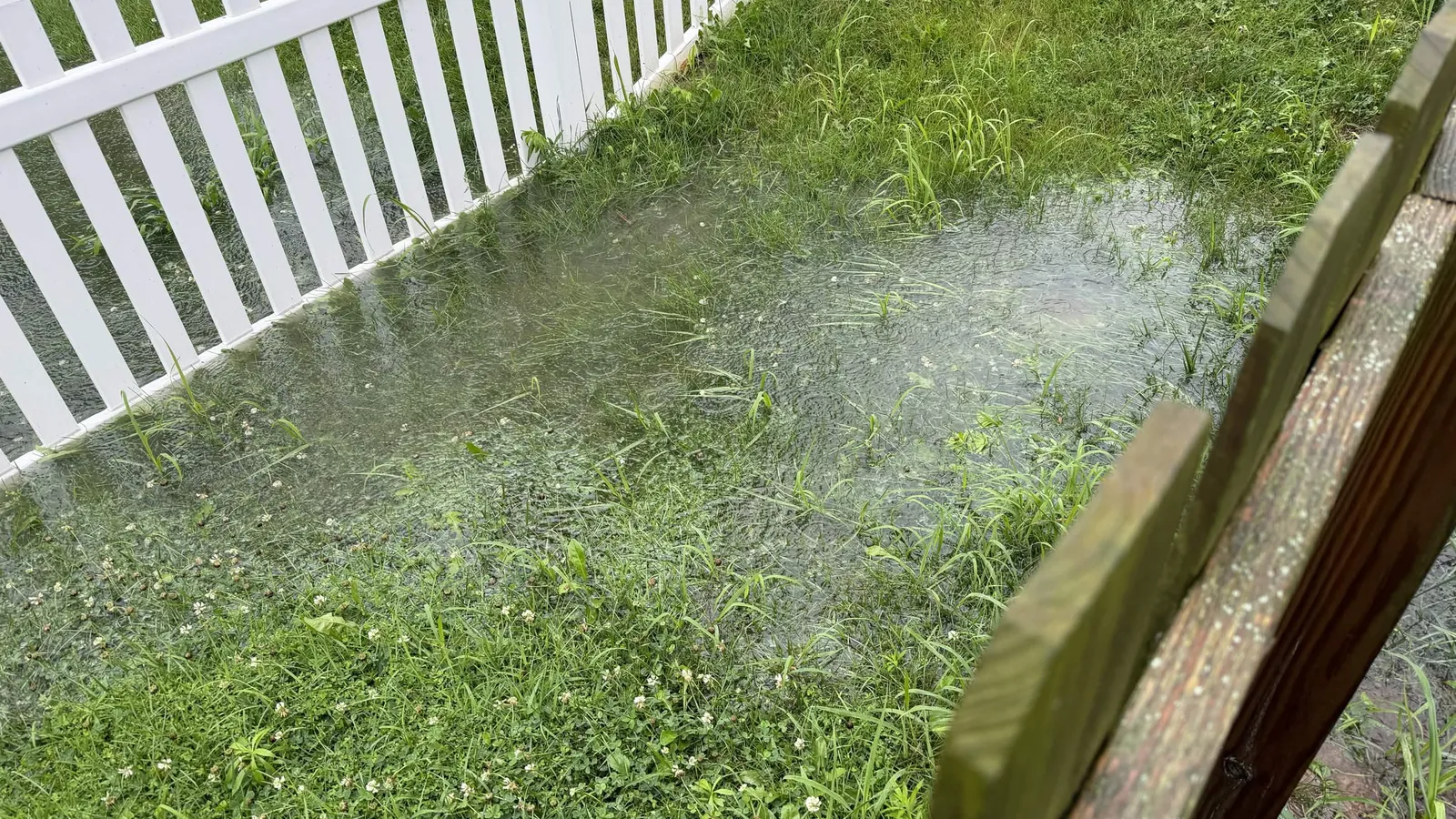
French drain vs trench drain: which one does your yard need?
A soggy lawn calls for a French drain. Water sheeting across a driveway or patio calls for a trench drain. A French drain is perforated pipe in a buried gravel trench, and it takes in water from the soil. A trench drain, also called a channel drain, is a grated channel set flush into the hard surface.
Angi draws the same line. French drains handle water that is underground, and trench drains move water off a surface. Cost guides do not all use the names the same way. It pays to know what each drain puts in the ground.
Three Crosses Land Services does French drain installation and underground downspout extensions for homes around Chattanooga. The work stays in the yard, in soggy lawns and along foundations. When the water runs across a slab instead, that is a trench drain set into the hardscape.
What is the difference between a French drain and a trench drain?
Where the water is when the drain catches it. A French drain takes in water that has already soaked into the soil. A trench drain catches water on top of a hard surface, where rain cannot soak in.
A French drain is a trench of washed gravel and perforated pipe, wrapped in filter fabric. Water works down through the stone, enters the pipe and runs to a lower spot. Angi notes the pipe carries water along a slope to an exit point. Landscaping Network says the point is to let the surface soil dry out.
A trench drain is a long channel with a grated cover, set flush into a hard surface. HomeGuide says trench drains go into driveways, patios, concrete slabs or between pavers. Angi adds pools and sidewalks. Landscaping Network says the grate catches water sheeting down the pavement, and the drain must be precisely leveled.
How can you tell which problem your yard has?
Watch where the water goes during a hard rain and the day after. Water that sits in the grass or keeps the ground soft is in the soil. Water that runs in a sheet across concrete or pavers is on the surface.
Water in the soil shows up in the same places every time. It stands in one low spot for days. One part of the lawn stays soft while the rest dries out. Angi calls French drains the best fit for soggy lawns.
Water on the surface looks different. Rain sheets down a sloped driveway toward the garage door, or a patio holds a puddle against the house. HomeGuide says driveway trench drains keep water from pooling at the garage or getting inside. Water across a slab calls for a trench drain set into the hardscape.
Roof water is its own case. Downspouts that empty at the wall soak the soil beside the foundation. An underground downspout extension ties the downspout into a solid pipe that carries the water away.
What does each one cost per foot?
Angi puts a French drain at about $10 to $50 per linear foot to install. It puts a trench drain at about $30 to $150. Landscaping Network lists $20 to $30 per foot for a French drain and about $70 for a trench drain. Angi says trench drains are the more expensive of the two to install.
| Drain | What it does | Published cost | Source |
|---|---|---|---|
| French drain | Takes in water from the soil | $10 to $50 per linear foot | Angi |
| French drain | Drains standing water so the surface soil can dry out | $20 to $30 per linear foot | Landscaping Network |
| Trench drain | Moves water off patios, pools, driveways and sidewalks | $30 to $150 per linear foot | Angi |
| Trench or channel drain | Sits flush in driveways, patios, slabs or between pavers | $30 to $150 per linear foot, by grate and channel material | HomeGuide |
| Trench drain | Catches water sheeting down pavement | About $70 per linear foot | Landscaping Network |
| Driveway trench or channel drain | Keeps water from pooling at a garage | $400 to $2,400 installed | HomeGuide |
| Dry well | Collects water underground | $300 to $1,000 per unit; $1,000 to $4,000 average cost | Angi |
| Catch basin | Takes in runoff at a low spot | $50 to $200 per unit; $600 to $2,000 average cost | Angi |
These are published national ranges from cost guides, not our price list. Angi’s 2026 national average for a whole yard drainage project is $4,635, and most homeowners pay $2,147 to $7,176. Chattanooga area French drain numbers are in our guide to what a French drain costs in Tennessee.
Angi says a French drain’s main costs are the labor to dig and cover up the piping. A trench drain adds a channel and a grate, and HomeGuide says that material moves its price. Landscaping Network lists saw cutting a driveway as one thing that can push a trench drain’s cost up.
How long does each one last?
Angi says a French drain can last 30 to 40 years if it is maintained. A trench drain can fail in as little as 2 to 5 years if the wrong one is installed.
A French drain is buried, so Angi warns a clog may not show until it causes a problem. Filter fabric wraps the stone and keeps dirt from plugging the pipe. Angi calls French drains mostly self-sustaining as long as they do not clog.
A trench drain sits in plain sight and catches what washes across the surface. Angi says the gaps in the grate collect larger debris, so the channel needs regular cleaning. It adds that heavy equipment or lawn tools like mowers can damage the grating.
Is a channel drain the same as a trench drain?
Yes. Both names mean a grated channel set into a hard surface. HomeGuide prices them as one item, the trench or channel drain.
The mix-up is with French drains. HomeAdvisor lists channel drain and trench drain as other names for a French drain. It calls that trench drain a surface-level style used in yards and driveways. Angi and HomeGuide treat the trench drain and the French drain as separate systems with separate prices.
So read a quote for what goes in the ground. Perforated pipe in a gravel trench is a French drain, whatever the line item says. A channel with a grate on top, set into concrete or pavers, is a trench drain.
Where do dry wells and catch basins fit in?
They are parts of a yard drainage system rather than a third choice. A catch basin works like an inlet, and Angi says catch basins intercept runoff at low spots. A dry well works like an outlet. Angi says it collects excess water underground, and HomeGuide calls dry wells good exit points.
HomeGuide adds that dry wells work best in sandy soils that drain well. Red clay soil is the opposite, since it holds water instead of taking it in.
Every French drain needs an outlet that sits lower than the drain, so gravity does the work. Ours run to the lowest usable point we can reach on the property. That might be a ditch line, a wooded edge, a swale or a pop-up emitter in the open lawn. We settle the outlet before anything is dug, because it sets the layout for the whole line.
What about water on a gravel driveway?
A gravel drive is a different case. The trench drains in these guides are built into paving. The grate sits flush in a slab or between pavers. A gravel drive sheds rain with its crown instead.
A drive with no crown holds rain in the tracks instead of shedding it. Gravel driveway repair fills the low spots and sets a crown so rain runs to the sides. Where the water runs wider than the drive, a French drain in the ground beside it carries the water off.
Why is water in the ground the common problem around Chattanooga?
Rain and clay. NOAA’s 1991 to 2020 normals put Chattanooga at about 55 inches of rain a year. Red clay holds that water, so a flat spot in the lawn can stay soggy for days.
Yards below a ridge also catch runoff from the higher ground above them. That water soaks into the lawn, and water in the ground is what a French drain is built for. A trench drain only helps where the rain lands on a hard surface first.
Getting a real answer for your yard
The free estimate starts with someone looking at the yard. We look at where the water starts and where it can go. That settles whether the yard needs a French drain, an underground downspout extension or both.
A photo taken during a hard rain shows which way the water runs. One taken the next day shows where it stands. Our mini skid steer fits through a standard fence gate, so a soggy backyard behind a fence is workable ground.
The prices above are published ranges from national cost guides. None of them is our rate card, and we price each drain off the yard itself.
Three Crosses Land Services is a veteran-owned family business based just north of Chattanooga, TN. We are licensed and insured, and we cover Chattanooga, Southeast Tennessee and Northwest Georgia. To get a soggy yard drained with a French drain, call or text (423) 260-5675.